

What to Ask When Evaluating a Fundraising Platform for Your Nonprofit
So many fundraising platforms to consider, so little time.
When every provider promises more donations, happier donors, and fewer admin headaches, comparing options can start to feel like you’re searching for a destination with no clear pathway in sight.
But when you know what to look for, you’ll be able to distinguish marketing fluff from a platform that actually delivers.
Here’s where to start – and what to ask before you decide.
1. Will It Provide a Smooth Donor Experience?
One of the first questions you’ll automatically ask when evaluating a fundraising platform is likely, “What does it cost?”
Now, I’m not saying it shouldn’t be a consideration, but prioritizing fees over the donor experience is a big mistake.
Attracting people to your donation page may be easy, but if the giving experience is frustrating, you might as well say goodbye to those donations.
Here are some questions to ask your potential provider:
Are donation pages optimized for mobile?
Can I customize donation forms and pages with branding, text, and visuals?
Do donors need to create an account before giving?
Is the checkout flow quick and easy?
A donation process that feels clunky or slow, and involves too many steps, quietly kills generosity. But when it’s quick, seamless, and signals trust? That’s what encourages donors to follow through with their gift.
2. Does It Support Donors’ Preferred Payment Methods?
Offering donors a variety of familiar payment methods is crucial to your fundraising strategy.
Since 63% of donors prefer to give online, your nonprofit should offer familiar options that align with their giving preferences. That’s how you’ll secure their trust, reduce friction, and inspire them to act.
Your chosen fundraising platform should support as many payment methods as possible. Credit/Debit cards, bank transfers, and bank redirects have become the industry standard, but today’s donors want even more options.
Modern donors expect giving to be quick and hassle-free. That’s why more organizations are offering digital wallet options. 79% of nonprofits offer PayPal on their donation page. Google Pay, Apple Pay, and Venmo are also common.
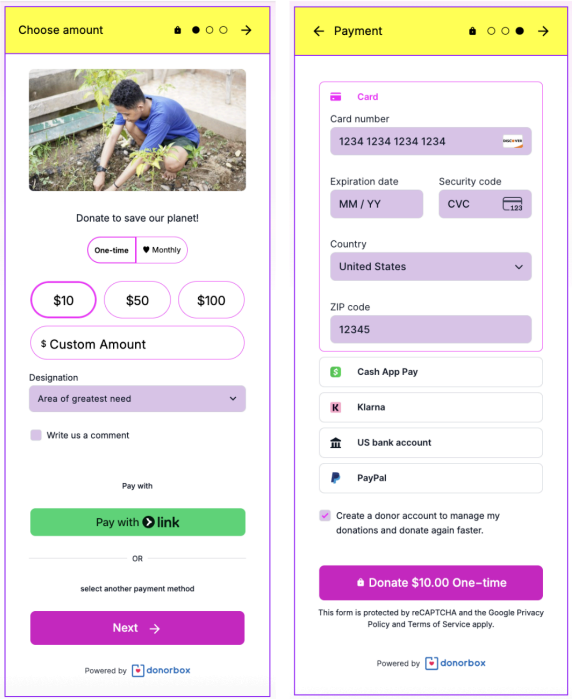
Donorbox, for example, makes it easy to appeal to more donors with its conversion–optimized OmniGive™ Donation Form. It supports more than 22 payment methods, helping you secure more donor dollars.
Donors can also enjoy a one-click giving experience using digital wallets on the first page of the form when UltraSwift™ Pay is enabled.
Here’s an example of a customized OmniGive donation form with UltraSwift Pay enabled, plus payment methods that appear based on a donor’s location and device:
The easier and faster you make it for donors to give, the more they’ll be willing to support your mission.
3. Does It Make Donor Management Easy?
Once a donor gives to your cause, that marks the beginning of a new relationship. Stewarding that relationship is crucial for retaining your donor and building a meaningful connection.
A strong fundraising platform should offer advanced donor management tools that simplify post-donation outreach. At the very least, it should:
Automate donation receipts to instantly acknowledge every gift.
Offer features to store and track supporter information and giving behavior.
Include advanced filters to segment donors for personalized messaging that resonates.
Ask:
Are donation receipts customizable and automated?
Do supporter profiles effectively track engagement history?
Does it integrate with my CRM and email marketing tools?
Can I easily export lists into CSV files for reporting and analyzing donor data?
Your fundraising platform should enable effortless donor management so supporters feel valued and inspired to keep supporting your cause.
4. How Easy Is It to Set Up and Manage Recurring Giving?
It’s no secret that recurring donations are the lifeblood of most nonprofits. Studies show that monthly giving accounted for 27% of all online revenue in 2025.
If donors have to jump through hoops to set up and manage their recurring gifts, you risk losing ongoing support that provides sustainable income, feeds donor retention, and increases their life-time value.
Here’s what to ask when evaluating a platform’s recurring donation capabilities:
Does the platform provide various recurring intervals to align with donors’ giving preferences?
Can donors easily set up a recurring donation and manage their receipts and plans independently via a donor portal?
How easy is it to manage and review recurring donation data
Recurring giving options should be visible, effortless to set up, and easy to manage – for both you and your donors.
5. Does the Platform Support Multiple Campaign Types?
Your fundraising strategy may rely on a platform that primarily supports one specific campaign type today, but that may change a year from now. As your organization grows, your fundraising needs will change – and that platform might fall short.
The ideal platform should offer various robust fundraising features and tools, including:
Crowdfunding
Peer-to-peer fundraising
Event management
Donation kiosk software for in-person fundraising
Text-to-Give
Memberships
Your platform should serve your changing fundraising needs and streamline your efforts – no platform or tool juggling needed!
6. How Simple Is Reporting?
The ability to effortlessly collect and analyze fundraising data is non-negotiable.
Make sure your platform provides helpful reporting tools to lighten your workload and efficiently analyze key fundraising and donor data in real time.
Opt for one that offers intuitive filtering options for pulling reports on donor and donation data.
Ask:
Is it easy to pull a list of new donors who supported a recent campaign to create an email welcome series?
What about filters for re-engaging lapsed donors?
Bonus points if it provides access to customizable reporting templates.
7. What Does Customer Support Actually Look Like?
Imagine this: You’re in the middle of a successful campaign, and your donation page is down. You contact your fundraising platform’s support team, but they take hours, if not days, to respond – never mind resolve the issue. That would make anyone want to pull their hair out.
Quality, 24/7 customer support is an often-overlooked but vital aspect when shopping for fundraising platforms.
Before you decide, check real-life user reviews on platforms like:
G2
Trustpilot
Capterra
Reddit and TechSoup forums
Pay close attention to reviews expressing similar issues, particularly after a user has committed to a platform. Your work matters, and nothing is worse than being told to wait 72 hours for a response.
How to Make the Right Decision
The ideal platform should make generosity easier, not more complex. Before you commit, test out the donation experience. Check out a donation form’s performance on mobile. Hear what other users have to say about their experiences.
Then, evaluate various platforms with your donors in mind. Ask:
How easy is it to set up a recurring donation?
Are familiar payment methods available?
Does the platform adapt to your brand and long-term fundraising needs?
Asking the right questions means fewer gray hairs in the future.
There are plenty of strong options out there. If you’re looking for one that ticks all the above boxes, I’d highly recommend Donorbox as a comprehensive fundraising and donor management platform.